What water hardness actually measures — and the units that matter
Water hardness is not one thing. The term describes the total concentration of dissolved calcium (Ca²⁺) and magnesium (Mg²⁺) ions, almost always expressed as equivalent calcium carbonate (CaCO₃) in milligrams per liter — which is the same as parts per million (ppm). The World Health Organization classifies soft water as below 60 ppm CaCO₃, moderately hard as 60–120 ppm, hard as 120–180 ppm, and very hard above 180 ppm. If you see hardness in German degrees (°dH), divide by 17.8 to get ppm CaCO₃. Clark degrees (°Clark), used mostly in older British literature, convert to ppm CaCO₃ at a factor of 14.3.
What separates a brewer's understanding from a plumber's is the distinction between temporary and permanent hardness. Both contribute to the total hardness number, but they behave completely differently — in the kettle, in the mash, and in the finished beer.
Temporary hardness is caused by calcium bicarbonate (Ca(HCO₃)₂) and, to a lesser extent, magnesium bicarbonate. The "temporary" label means exactly what it says: this hardness disappears when you boil the water. The bicarbonate decomposes, carbon dioxide is driven off, and calcium carbonate precipitates as limescale. That white crust in your kettle is temporary hardness made visible. The practical consequence for brewers is significant — boiling your water before mashing strips out bicarbonate, which otherwise raises mash pH and causes problems for pale beers.
Permanent hardness is caused by calcium sulfate (CaSO₄, gypsum) and calcium chloride (CaCl₂). These compounds do not precipitate on boiling. They remain dissolved in the water, pass into the mash, survive the boil, and end up in the finished beer. That makes permanent hardness the primary concern for flavor engineering. The ions it contributes — sulfate and chloride — are the ones that most directly shape how bitterness and body feel in the glass.
How bicarbonate derails a pale mash — and why dark malts neutralize it
Mash pH is one of the tightest tolerances in brewing. The enzymes that convert starch to fermentable sugars — alpha and beta amylase — are most active between pH 5.2 and 5.6. Push the pH above 5.8 and enzyme activity slows, conversion efficiency drops, and you lose fermentable extract. Push it above 6.0 and starch conversion becomes measurably incomplete. These are not theoretical thresholds; brewers track mash pH with calibrated meters and adjust it gram by gram.
Bicarbonate is the antagonist here. It is alkaline, and it pushes mash pH upward, resisting acidification. The alkalinity of 100 ppm CaCO₃ of bicarbonate is large enough to shift a pale mash well above the ideal window. The consequences go beyond conversion efficiency. At elevated pH, the Maillard reaction during wort boiling intensifies, pushing wort color darker than the grain bill warrants. Bitterness from hops extracted at high pH tends to read coarser and more astringent on the palate rather than clean and crisp. Protein-haze potential also increases. Everything goes wrong at once.
The resolution, historically, was dark malt. The roasted grain in a stout or porter is acidic — its pH can sit as low as 3.5–4.0. Put enough dark malt into a high-bicarbonate mash and the two forces cancel. Dublin's water, with its 200+ ppm bicarbonate, would be catastrophic for a pale lager; for a dry stout with 10–15% roasted barley, it becomes a natural buffer. The water and the grain bill solve each other's problems, which is a large reason why the dry stout style took root where it did. London's moderately carbonate water produced rounder, slightly darker ales for the same reason — the mineral profile nudged brewers toward recipes that worked with it.
Modern breweries that want to brew dark styles on soft water add a small amount of sodium bicarbonate or calcium carbonate to the mash to deliberately raise pH into the 5.4–5.6 range, preventing over-acidification from roasted malts. The principle runs both ways: adjust mineral additions to match the grain bill, not the other way around.
Sulfate vs. chloride: the ratio that controls how every beer tastes
Sulfate (SO₄²⁻) and chloride (Cl⁻) are the two ions in permanent hardness that most directly shape flavor perception. Neither of them tastes like much at typical brewing concentrations. What they do instead is alter the way the palate receives everything else — hop bitterness, malt sweetness, body.
Sulfate sharpens and dries bitterness. At 50 ppm, the effect is subtle. At 150–200 ppm, bitterness reads crisper and longer-lasting. At 400+ ppm, as in Burton-on-Trent's legendary well water, the drying effect is aggressive enough to define an entire category of beer. The mechanism is not completely pinned down at the molecular level, but the sensory reality is well-documented: more sulfate, more perceived bitterness, drier finish. This is why hop-forward pale ales and IPAs are typically brewed with elevated sulfate — 150 to 350 ppm is a common target range.
Chloride does the opposite. It rounds the palate. It accents malt sweetness and adds a sense of fullness and body that sulfate strips away. At 100–150 ppm, a malt-forward beer drinks rounder, almost creamier, without tasting salty. Beyond 200 ppm, chloride starts to contribute a mineral edge that most brewers avoid. The practical floor is around 50 ppm — below that, the effect is negligible.
The number brewers watch most is the sulfate-to-chloride ratio. A ratio of 2:1 or higher tilts the beer toward dry and hop-forward. Below 1:1 — more chloride than sulfate — and the beer reads maltier and rounder. The same recipe, the same hops, the same grain bill; shift the ratio and you change the character of the beer. This is not subtle. Trained tasters can detect sulfate-to-chloride differences of 50 ppm in a triangle test.
| Sulfate : Chloride ratio | Typical character | Best-suited styles |
|---|---|---|
| 4:1 or higher | Very dry, assertive bitterness, long finish | West Coast IPA, Burton-style pale ale |
| 2:1 to 3:1 | Dry, clean, hop-accented | American pale ale, German Pils, dry lager |
| 1:1 (balanced) | Balanced, neither dry nor sweet | Czech Pils, light lager, Kölsch |
| 1:2 to 1:3 | Round, full, malt-accented | English bitter, Irish stout, malt-forward lager |
| 1:4 or lower | Very soft, full, almost creamy | Milk stout, dunkel weizen, pure-draft lager |
Four cities, four water profiles, four great styles — and what they teach us
Before reverse osmosis and dosing pumps, brewers were geologically constrained. The styles that survived and spread were the ones that worked with the local water, not against it. These four examples remain the reference points that professional brewers cite when designing a target mineral profile.
Pilsen, Czech Republic. Among the softest natural brewing water in the world. Total hardness often below 30 ppm CaCO₃. Sulfate around 5–10 ppm. Bicarbonate negligible. This near-blank canvas is exactly why Josef Groll's Pilsner Urquell of 1842 could be so pale, so delicate, so improbably clear and clean for the era. There was nothing in the water to coarsen the bitterness, darken the wort, or cloud the beer. The style is, in a literal sense, a product of Bohemian geology. Soft water and delicate pale lager remain inseparable.
Burton-on-Trent, England. The geological opposite of Pilsen. Burton sits on a formation of Triassic sandstone saturated with gypsum. Historical analyses of Burton well water show sulfate levels of 600–800 ppm — numbers that most water treatment systems would need to manufacture deliberately. Calcium runs 250–300 ppm. Magnesium is elevated too, at 60–90 ppm. At those sulfate concentrations, hop bitterness is amplified, dried, and extended in a way that no other water chemistry replicates naturally. The result was the original pale ale and IPA — styles so tied to their water that other English breweries began adding gypsum to replicate the effect. "Burtonisation" became a standard industry practice in the 19th century and remains used today.
London, England. Moderately hard water with a significant bicarbonate load — around 120–160 ppm alkalinity — and moderate sulfate and chloride. That bicarbonate profile inhibits very pale, delicate beer, but it is neutralized by the small proportion of dark malts in a porter or a mild. London's water bias helped establish the porter and brown ale traditions: moderate malt darkness, rounded bitterness, slightly sweet finish. London's chloride-forward hardness also contributes to the soft, full mouthfeel that characterizes English session ales.
Dublin, Ireland. High carbonate — bicarbonate typically above 200 ppm — with low sulfate and moderate chloride. That alkalinity works destructively on pale grain bills but is neutralized by the heavily roasted barley in a dry stout. Guinness's iconic dry stout was shaped not just by recipe choices but by the chemistry of the Liffey's water. The style is, from a water-chemistry standpoint, the correct beer for Dublin's geology. Chloride-forward permanent hardness contributes to the characteristic smoothness and body of Irish stout despite the roasted austerity of the grain.
Reverse osmosis, mineral rebuilding, and why Qiandao Lake is a genuine starting advantage
Modern commercial breweries are no longer prisoners of their local geology. Reverse osmosis (RO) forces water through a semi-permeable membrane under pressure, rejecting 95–99% of dissolved ions. The output is water that is essentially mineral-free — total dissolved solids (TDS) below 20 ppm, near-zero hardness. From that blank slate, the brewer adds salts in gram-per-hectoliter doses: calcium sulfate (gypsum) for sulfate and calcium; calcium chloride for chloride and calcium; sodium chloride for sodium and chloride; magnesium sulfate (Epsom salt) for magnesium and sulfate; sodium bicarbonate or calcium carbonate for alkalinity when dark malts demand it.
This sounds like total control, and in a laboratory sense it is. The practical reality is that RO is expensive in energy and equipment, produces a reject stream of concentrated minerals that requires disposal, and demands precise measurement at every batch. Brewing the same recipe from RO water in two different sessions and hitting the same mineral profile within ±5 ppm requires documented procedures, calibrated dosing equipment, and rigorous water analysis. It is achievable — large-scale lager breweries do it routinely — but it introduces variables that a clean natural source water eliminates.
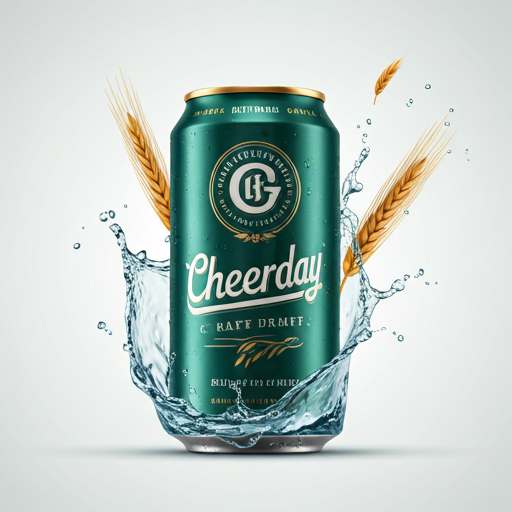
Qiandao Lake water arrives at Cheerday's facility with a profile that most breweries would need an RO system to manufacture. TDS is very low. Total hardness is soft — well below 60 ppm CaCO₃ by most measurements. Alkalinity from bicarbonate is minimal. The starting pH is near-neutral. Municipal treatment adds chlorine for disinfection, which is removed by carbon filtration before the water enters the brewing process — a standard and straightforward step. What remains is essentially a clean, soft blank canvas.
From that baseline, targeted mineral additions are made by style. For pale lager and pilsner-type beers — where clean hop bitterness and brilliant clarity are priorities — calcium sulfate is added to bring sulfate into the 80–150 ppm range and calcium up to 50–80 ppm. For the pure-draft and malt-forward line, where roundness and body are the goal, calcium chloride is preferred, bringing chloride to 80–120 ppm while keeping sulfate below 50. For the lightest, most water-transparent styles, the natural Qiandao Lake profile is left nearly untouched — there is no mineral load to fight and no corrections required. That flexibility — the ability to go in any direction from a low baseline — is what a clean soft source water actually delivers in practice.
By comparison, a brewery drawing from hard well water with 300 ppm bicarbonate and 250 ppm calcium faces a different problem. Stripping those minerals requires either full RO or a multi-step pre-treatment (lime softening, ion exchange), each with its own cost and complexity. Adding 50 ppm of sulfate to clean water is a single weighing operation. Removing 250 ppm of unwanted bicarbonate is a capital project. The Qiandao Lake source is, from a water-chemistry standpoint, a head start that money can partially replicate but cannot fully substitute.
Frequently Asked Questions
What is "hardness" in water and how is it measured?
Water hardness measures the concentration of dissolved calcium and magnesium ions, expressed as equivalent calcium carbonate (CaCO₃) in mg/L (ppm). Soft water is below 60 ppm CaCO₃; hard water above 180 ppm. Temporary hardness comes from calcium and magnesium bicarbonates that precipitate when the water is boiled — this is why boiling hard water forms limescale (calcium carbonate). Permanent hardness comes from calcium sulfate and calcium chloride, which do not precipitate on boiling and remain in the water (and thus in the beer) regardless of heat treatment.
Why did Burton-on-Trent become famous for IPA?
Burton-on-Trent in England sits on a geological formation rich in calcium sulfate (gypsum). Its well water contains 600–800 ppm sulfate — an extraordinary mineral loading that most brewing water would need to have added deliberately. At those sulfate levels, hop bitterness is dramatically enhanced and perceived as dry, clean, and long-finishing rather than harsh. When Indian Pale Ale was developed for export to India in the 19th century, the high sulfate Burton water amplified the hop character that was added for preservation. Brewers in other locations discovered that adding gypsum to their water ("Burtonisation") replicated this effect.
What does Cheerday do with its Qiandao Lake source water before brewing?
Qiandao Lake water arrives at our facility as one of the cleanest brewing water sources in China — very low TDS, soft, near-neutral pH. Standard municipal treatment adds chlorine for disinfection, which we remove by carbon filtration. Depending on the beer style being brewed, we then add specific minerals in precise amounts: calcium sulfate for our pale lager and pilsner styles (to enhance bitterness and dryness), calcium chloride for our pure-draft and malt-forward styles (to enhance roundness and body), and nothing additional for our water-forward light styles that benefit from the natural purity of the source.
The takeaway
Water hardness is not a single number to optimize — it is a set of chemical levers, each of which shapes a different aspect of the finished beer. Bicarbonate controls mash pH and enzyme efficiency. Sulfate controls bitterness perception. Chloride controls body and fullness. The style you are brewing determines which levers to pull and how far. Starting from a clean, soft source like Qiandao Lake means pulling in any direction is easy; starting from hard, carbonate-heavy water means removing first and then rebuilding. For distributors sourcing a lager, a pure-draft, or a specialty line, the mineral foundation behind Cheerday's beers is not a marketing claim — it is a measurable water chemistry advantage built into every batch. Reach out to our export team to discuss your market and which product range fits it.
Talk to our export team