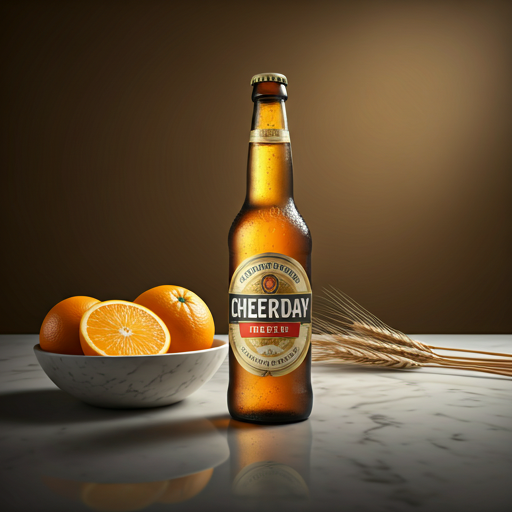
Where CO2 in beer comes from — and why it matters which route
Every molecule of CO2 in a finished beer was produced by yeast. During active fermentation, Saccharomyces cerevisiae converts sugars to ethanol and CO2 at roughly a 1:1 molar ratio — for every gram of ethanol produced, about 0.96 grams of CO2 are generated. In an open or loosely sealed fermenter, most of that CO2 simply vents to atmosphere. The question is how much you retain and what you do with it.
There are two practical routes. The first is natural carbonation (sometimes called spunding): the brewer seals the conditioning tank while a small calculated amount of fermentable sugar remains, trapping the CO2 produced by that final fermentation under pressure. The gas dissolves into the cold beer during lagering. The second route is force carbonation: the beer is fermented to completion, CO2 is vented, and pure CO2 is injected at controlled pressure into the cold, finished beer until the target level dissolves. Both can produce an identical final carbonation level. The difference is process control and economics, not product quality — though natural carbonation does produce slightly finer, more tightly integrated bubble structure in many brewers' experience.
What neither route changes is this: CO2 in beer is a dissolved gas held in solution by cold temperature and pressure. The moment that pressure is released — the can opens, the pint is poured — the gas begins its journey back out. The bubbles you see are not carbonation leaving the beer; they are carbonation that has already left. The carbonation that matters for flavour is the CO2 still dissolved in solution.
Volumes, grams per litre, and what the numbers mean across styles
Carbonation is expressed two ways. Volumes of CO2 is the traditional brewer's unit: one volume means one litre of CO2 gas (at 0°C and 1 atm, i.e. standard conditions) dissolved per litre of beer. To convert to grams per litre, multiply by 1.96 — so 2.5 volumes equals 4.9 g/L. European and Asian producers often prefer g/L; American craft brewers almost universally use volumes. Same measurement, different notation.
The ranges across styles reflect how carbonation interacts with each beer's flavour architecture. A soft, malt-forward British cask ale is served at 1.2–2.0 volumes — low enough that it doesn't scrub the malt aromatics away. An American macro lager sits at 2.5–2.8 volumes, where the sharp prickle masks the thin body and suppresses any residual sweetness. German Helles and Munich lagers target 2.4–2.6 volumes — brisk but not aggressive, clean and refreshing without being fizzy. Belgian witbier runs higher, 2.8–3.2 volumes, because the style's spicy esters and wheat body can absorb that prickle without becoming harsh. Hefeweizen is the outlier: 3.5–4.0 volumes is the target, producing the vigorous, rocky white head and the almost effervescent mouthfeel the style demands. That carbonation level is also functional — it carries banana and clove esters directly into the headspace the moment you pour.
| Style | Typical Range (vol CO2) | Equivalent (g/L) |
|---|---|---|
| American Lager | 2.5–2.8 | 4.9–5.5 |
| German Helles / Munich Lager | 2.4–2.6 | 4.7–5.1 |
| Belgian Witbier | 2.8–3.2 | 5.5–6.3 |
| British Cask Ale | 1.2–2.0 | 2.4–3.9 |
| Hefeweizen | 3.5–4.0 | 6.9–7.8 |
Measuring carbonation in-package is done with a pressure/temperature method: you shake the sealed container to equilibrate the headspace gas with the dissolved CO2, read the gauge pressure and the liquid temperature, then look up the result on a carbonation table. Modern lines use in-line CO2 sensors that measure dissolved CO2 directly and continuously during filling, flagging any can or bottle that packages outside the target band before it leaves the line.
Mouthfeel, carbonic acid, and why fizz feels the way it does
Dissolved CO2 reacts with water to form carbonic acid (H2CO3). The concentration is low — carbonic acid is a weak diprotic acid — but it is enough to lower the beer's pH slightly and, crucially, to activate the TRPA1 ion channels on trigeminal nerve endings in the mouth and throat. The trigeminal nerve is not part of the taste system; it handles pain and temperature. This is why carbonation does not taste prickly or sour so much as it feels prickly — the sensation is closer to mild pain than flavour, which is why high-carbonation beer registers as refreshing and sharp rather than sweet or bitter.
The perceived dryness of a highly carbonated beer is partly trigeminal and partly real. Carbonic acid reacts with salivary proteins and the protein in beer itself, subtly coagulating them and reducing the lubricating mucin layer on the tongue. The result is a slight astringency — a drying, tightening sensation that can be mistaken for bitterness by tasters who haven't calibrated for it. High-carbonation styles like Hefeweizen and witbier balance this with a substantial body from wheat malt; strip that body away and the same carbonation would feel harsh.
Temperature modulates all of this. A warmer beer releases CO2 faster into the headspace, reducing dissolved CO2 quickly. A colder beer holds CO2 in solution longer, so the carbonation sensation persists through the whole drink. This is why lager styles almost always specify a lower serving temperature than ales — the style was engineered around the cold-serving experience, not adapted to it.
How carbonation suppresses sweetness and sharpens bitterness
The interaction between carbonation and the basic tastes is measurable and significant. Sweetness is suppressed. The carbonic acid and the mild acidity it produces compete with sweet receptors on the tongue — the same mechanism that makes sparkling water taste less sweet than flat water when you add sugar to both in equal amounts. For a malt-forward lager with residual sweetness, carbonation is doing active work to keep the beer from tasting cloying. American macro lagers are a worked example: a 2.5–2.8 vol carbonation on a beer with 1–2 g/L residual extract keeps the palate clean where the same beer served flat would taste thin and slightly sweet in an unflattering way.
Bitterness is amplified. This is the interaction most experienced tasters notice first. The trigeminal prickle adds a physical sharpness that sits on the same part of the palate where iso-alpha acids register, and the slight pH drop from carbonic acid intensifies the perception of hop bitterness. The practical consequence: a beer that tastes balanced at 2.6 volumes may taste noticeably more bitter at 3.0 volumes with no change in hopping rate. Recipe developers account for this by adjusting IBU targets alongside carbonation targets — they are not independent variables.
Acidity also interacts, though more subtly. Beers with higher inherent acidity — sour ales, fruit beers, Berliner Weisse — are often carbonated at the higher end of their style range because the acidity and carbonation reinforce each other to produce a clean, bright, refreshing finish. Under-carbonate a sour beer and it can taste flat and vinegary rather than lively and tart. Over-carbonate a barely-acid pale lager and the prickle overwhelms the delicate grain character.
CO2 bubbles as aroma carriers — and the physics of nucleation
Each rising CO2 bubble is a tiny scrubbing column. As it forms and travels upward through the beer, it adsorbs volatile aroma compounds — hop terpenes, ester esters, fusel-derived aromatics — onto the bubble surface. When the bubble bursts at the surface, those compounds are ejected into the headspace at concentrations many times higher than what evaporation alone would achieve. This is why a freshly poured carbonated beer is dramatically more aromatic than a flat sample of the same beer — you are smelling the concentrated output of thousands of bursting bubbles acting as aroma pumps.
The bubbles need a starting point. CO2 does not spontaneously nucleate from clear, smooth liquid in a lab-clean glass — it requires a nucleation site: a tiny surface discontinuity, a dust particle, a hydrophobic fiber, a scratch in the glass. This is why an etched glass (deliberate scratches cut into the base) produces a steady column of fine bubbles; why a clean glass produces far fewer; and why a glass contaminated with dishwasher residue or lipstick produces large, irregular bubbles or excessive foaming. It is also why canned beer poured directly into a clean plastic cup often looks flatter than the same beer in a scratched pub glass — fewer nucleation sites, fewer bubble columns, less visual carbonation.
Pour angle and turbulence control nucleation at the point of dispense. A slow, angled pour along the glass wall produces a controlled foam head without excessive agitation — the CO2 comes out gradually in fine bubbles that cap into a tight, persistent head. A straight, aggressive pour forces rapid nucleation, produces large bubbles that collapse quickly into a coarse, short-lived head, and strips a measurable fraction of total CO2 from the beer before you drink it. The physics are the same for Cheerday's draft lines and for a homebrewer cracking a can: pour technique is not ritual, it is quality control.
For Cheerday's lager range, the target carbonation of 2.5–2.7 volumes is set to deliver an active bubble column in a properly cleaned glass, a persistent white head on a clean pour, and a palate that reads crisp without crossing into harsh prickle. The Hefeweizen-adjacent wheat styles in the craft line target 3.2–3.6 volumes to support the wide, dense foam that characterises those beers and to drive the banana and clove esters into the nose. Each batch certificate of analysis (CoA) available to wholesale buyers includes the measured in-package CO2 level alongside alcohol, extract, and microbiological results.
Carbonation FAQ
Why does beer go flat in a warm glass?
CO2 solubility in water decreases as temperature increases — this is the opposite of most solutes. At 4°C, beer can hold approximately 2.8 volumes of CO2 at atmospheric pressure; at 20°C, the same pressure holds only about 1.5 volumes before the beer becomes supersaturated and CO2 escapes. A cold beer poured into a warm glass loses carbonation more rapidly than one poured into a chilled glass. Additionally, nucleation sites on the glass surface (dust particles, surface imperfections) create continuous bubbling that accelerates CO2 escape. This is why beer quality professionals recommend chilling glassware and minimising pour turbulence.
What are "volumes of carbonation" and how do I convert to other units?
One volume of carbonation means one volume of CO2 gas dissolved per volume of liquid — so 2.5 volumes means 2.5 litres of CO2 (at standard temperature and pressure) dissolved per litre of beer. To convert to grams per litre: multiply volumes by 1.96. So 2.5 volumes = 4.9 g/L CO2. To convert to bar pressure (at a given temperature), you need a carbonation table or the Henry's Law calculation — CO2 solubility is both pressure and temperature dependent, which is why carbonation tables list both variables.
How does Cheerday carbonate its beer?
Primary carbonation in Cheerday beer comes from fermentation — the CO2 produced by yeast during fermentation is captured by sealing the tank during the later stages of fermentation (a process called "natural carbonation" or "spunding"). The residual CO2 dissolves into the cold beer during lagering. Final carbonation levels are measured before packaging using an in-line CO2 meter, and any adjustment needed is made by adding or removing CO2 through controlled pressure management. The target range varies by style as specified in the recipe, and each batch CoA includes the measured CO2 content.
The takeaway
Carbonation is a lever that touches every dimension of beer quality — mouthfeel, bitterness, sweetness, aroma delivery, and head retention. Getting it right means specifying a target by style, measuring it precisely before packaging, and protecting it through the cold chain to the glass. Cheerday publishes CO2 levels on every batch CoA. For distributors, importers, and wholesale buyers who want to understand the full technical specification of our lager and craft range, our export team can provide the complete documentation. Tell us your market and the volumes you need, and we will put together the right proposal.
Talk to our export team